Safe, structured payments for printing equipment, parts, and services
In international B2B trade, trust is one of the most important parts of any transaction. Buyers want to know that their money will not disappear before the agreed work is done. Sellers want to know that a serious client is ready to pay and that the platform supports an orderly, transparent process. That is why many modern marketplaces use an escrow-style payment model.
In general terms, escrow is a controlled payment arrangement in which funds are placed into a protected transaction flow and are not immediately released to the seller. Instead, the payment is held until the conditions of the deal are met. In traditional commerce, escrow is often used in higher-value or more sensitive transactions where both sides need additional confidence. On digital marketplaces, this principle is usually implemented through a structured payment system that separates the moment of payment from the moment of payout. PressInspection uses this logic to create a safer and more professional environment for printing industry transactions.
How this works on PressInspection
PressInspection uses a Stripe-powered marketplace payment flow. In practical terms, this means the payment is made through the platform, recorded within the platform’s transaction logic, and then transferred to the seller according to the rules of the deal and the marketplace workflow. Stripe Connect supports marketplace models in which a charge can be created on the platform and funds can then be transferred to one or more connected sellers. Depending on configuration, the platform can also retain funds in its balance before payout is made.
This is important because PressInspection is not just a simple classifieds website. It is a professional B2B marketplace for printing equipment, parts, inspections, technical services, and custom requests. Transactions on the platform may involve cross-border suppliers, private offers, service coordination, lead time confirmation, technical scope approval, or staged communication between buyer and seller. A direct and uncontrolled payment from buyer to seller would often be too risky for this type of environment. An escrow-style model helps create order, traceability, and confidence for both sides.
Escrow-style protection in the Marketplace
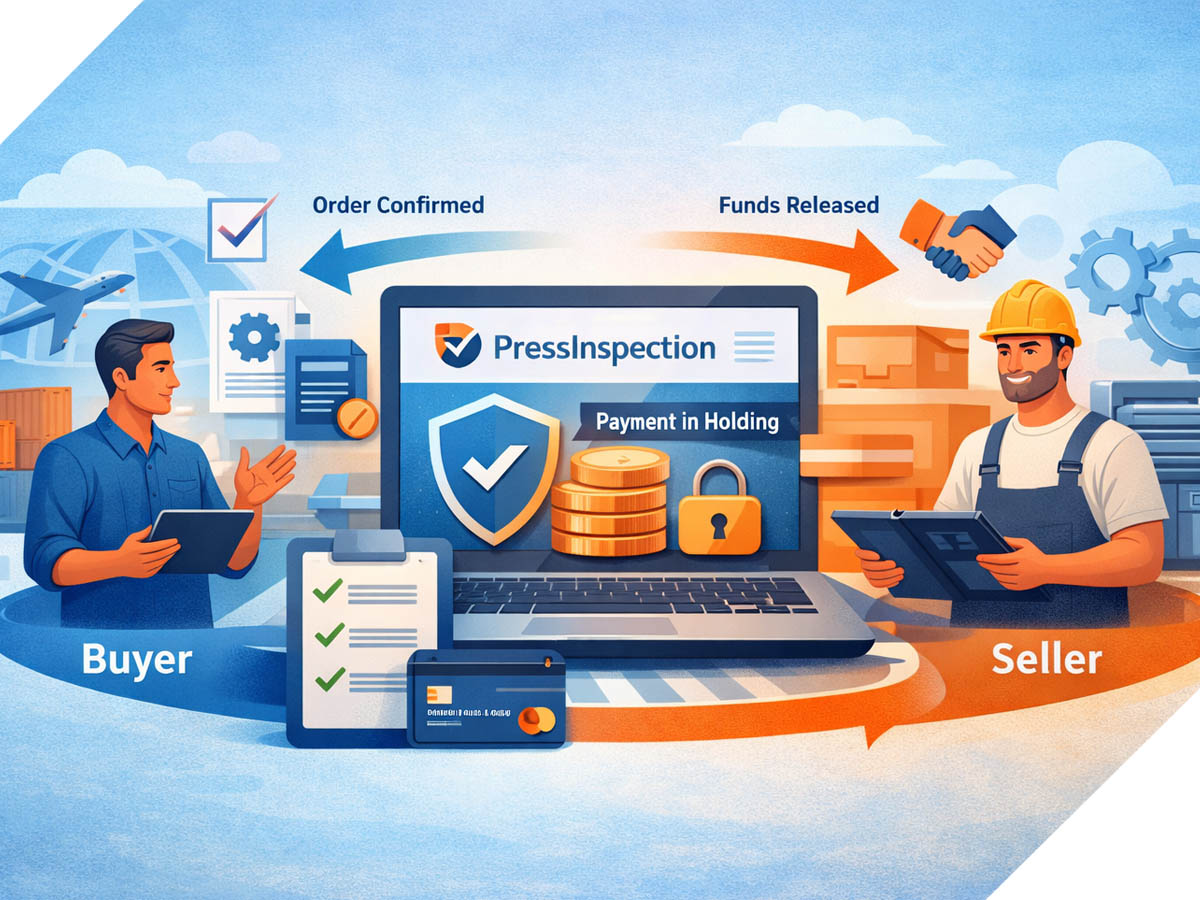
For standard marketplace orders, the logic is simple: the buyer places an order and pays through PressInspection’s secure checkout. The payment enters the platform-controlled transaction flow instead of being treated as an informal off-platform transfer. The seller receives confirmation that the order is backed by a real payment, while the buyer gains the reassurance that the transaction is documented and processed through an established payment infrastructure.
This approach gives both parties a clearer framework. The buyer can place an order knowing that the transaction is recorded inside the platform. The seller can prepare the product or service knowing that the order is financially confirmed. PressInspection can then apply the agreed order logic, including platform fees, transaction status handling, and payout timing. Stripe’s marketplace tools are specifically designed for this kind of flow, including split payments, platform fees, retained balances, and payout management for connected accounts.
For the user, the result is straightforward: payment is not treated as a blind transfer between strangers. It becomes part of a structured marketplace process with clearer accountability. This is especially valuable in the printing industry, where orders may involve used machinery, technical inspections, time-sensitive services, special parts, or international logistics.
Escrow-style protection in Requests
The Requests system on PressInspection is even more dependent on trust and clarity. A request may start with a custom need: for example, a machine inspection, emergency service, spare part sourcing, troubleshooting, relocation support, or a tailored technical consultation. In these cases, there is often no fixed product card at the beginning. The transaction begins with a buyer request, seller responses, and then a custom offer.
Here, the escrow-style logic becomes especially useful. A buyer can submit a request, receive a tailored offer, and proceed to payment through PressInspection once the scope and price are accepted. The payment is then linked to that specific request and tracked inside the platform workflow. This gives the seller confidence that the buyer has committed financially, while giving the buyer confidence that the payment is connected to a defined offer rather than an informal email conversation or private bank transfer.
In other words, the Requests system turns custom B2B negotiations into structured, payable transactions. Instead of relying on trust alone, both sides work within a platform-controlled process: request, offer, payment, execution, and payout. This is particularly important for services where the value lies in expertise, response time, or access to a qualified specialist, and where the buyer needs confidence before funds are released. Stripe’s Connect model supports platform-defined payment flows and leaves responsibility for payout logic, refunds, and dispute handling to the marketplace according to its configuration and policies.
Who controls the payment process
PressInspection manages the transaction workflow, while Stripe provides the payment infrastructure. This means payment processing is handled through Stripe’s secure marketplace tools, but the platform defines how a transaction is structured inside PressInspection: when an order is considered placed, how a request becomes payable, how commissions are applied, and when payout to the seller is initiated under the platform rules. Stripe also makes clear that refunds, disputes, and negative balances are handled according to the account where the charge was made and the chosen marketplace setup.
For users, this creates a balanced system. Buyers receive a more controlled and transparent payment path. Sellers receive better payment certainty than in informal off-platform deals. And the marketplace can maintain a documented, professional transaction structure suitable for serious B2B trade.
Why this matters
PressInspection is built for complex printing-industry transactions, not only simple online purchases. Many deals on the platform involve technical evaluation, custom scope, service scheduling, private offers, or specialized equipment. In such an environment, trust must be built into the payment process itself.
That is the purpose of our escrow-style system: to reduce uncertainty, support serious buyers and sellers, and turn complex industry transactions into safer, clearer, and more manageable deals.