
What you can sell on Pressinspection
On our platform you can offer multiple types of listings at the same time — this is normal and often the best strategy:
-
Google Meet consultations
— consultations of 15 / 30 / 45 minutes (and other formats if available in your plan/settings). -
On-site service engineer visits (On-site services)
— for these services, “shipping” can mean travel costs (transport, accommodation, etc.) and may vary depending on distance. -
Repair / refurbishment with shipment of a part/product
— the customer ships the part to you, you complete the work, then ship it back. -
Freelance services
— services can be provided not only by self-employed specialists, but also by print shops/companies (e.g., packaging design, prepress, color management, production audits, etc.). -
Physical goods
— equipment upgrade kits, measuring devices, new/used machines, rollers, and more.
Important: one vendor can combine goods and services in one store — the key is that your listings are clear and honest.
A) How to register and complete your profile
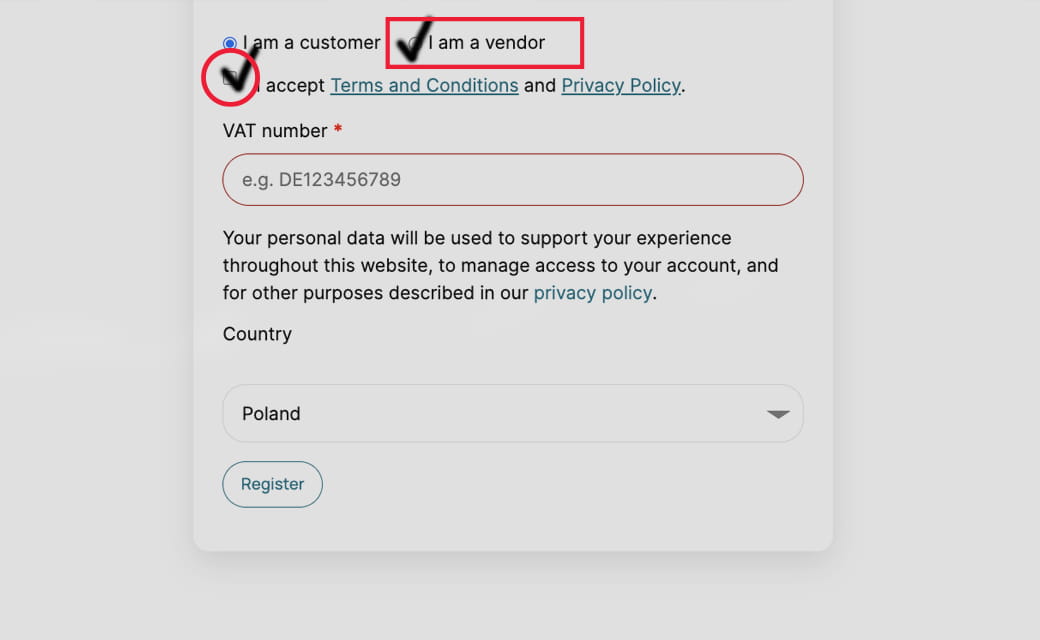
Step 1. Vendor registration
Create a vendor account and log in to your Vendor Dashboard.
Screenshot A1: Registration / login page
Step 2. Fill in your profile and store settings (Store Settings)
In the dashboard you will see a profile completion indicator (often called Profile Progress / Profile Completion). It helps you understand what is still missing so your store looks professional and you can receive payouts.
The indicator typically increases when you add:
-
Store Name
-
Store URL (your store page address, e.g.,
/vendor/username) -
Logo and Banner
-
Store Address / Country
-
Phone / Contact
-
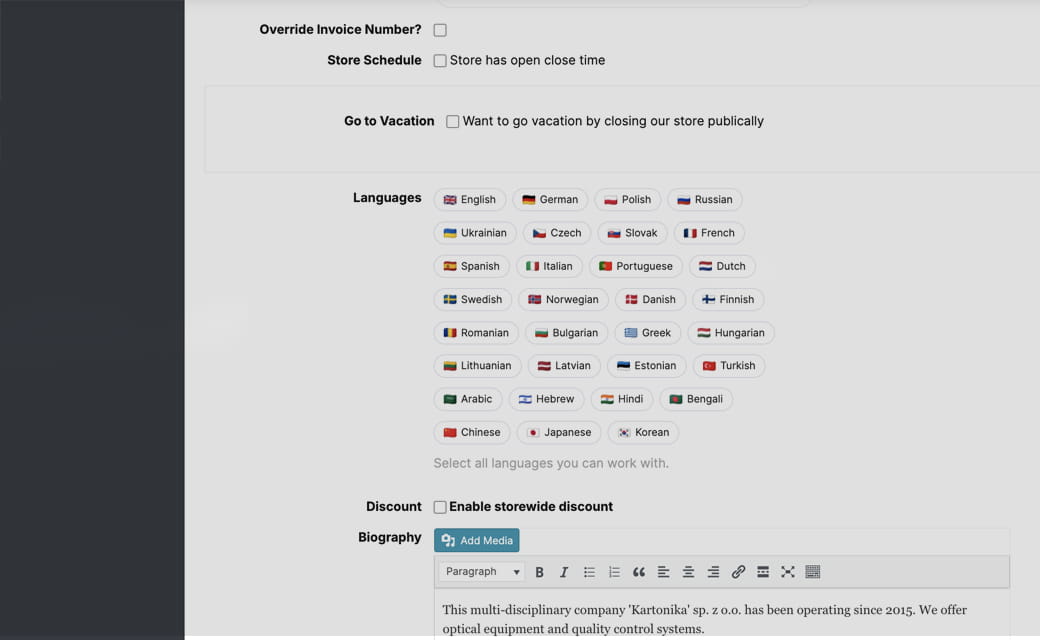
Store Description (what you do and how you help the market)
-
Languages (languages you can work in)
-
Social Profiles (links to your social media/portfolio)
-
Payment Settings (payout details)
Screenshot A2: Profile Progress / Profile Completion widget
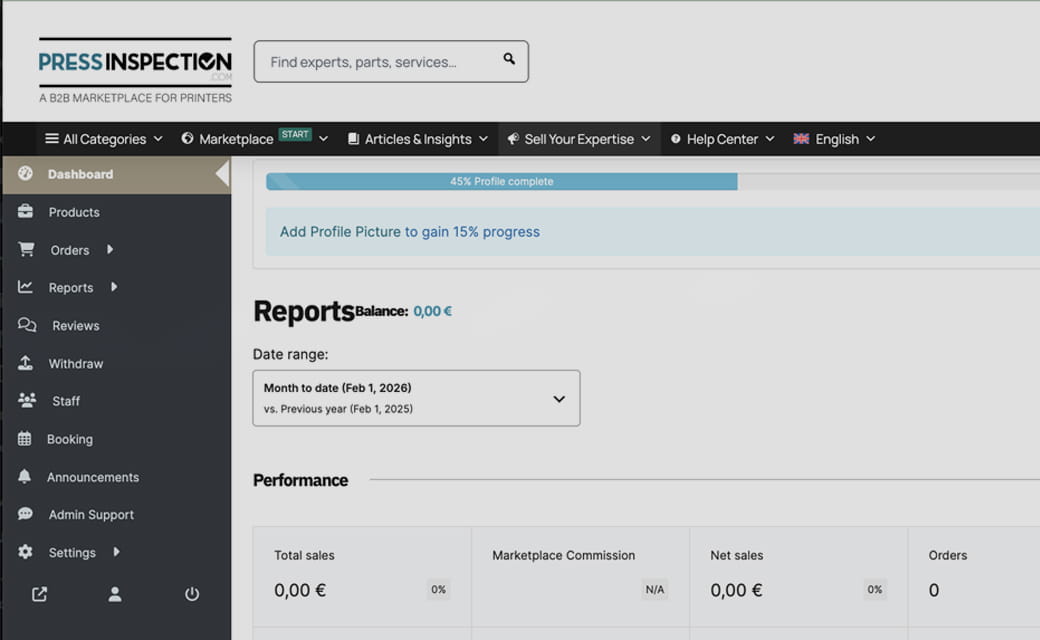
Recommendation: aim for 90–100% completion. Complete profiles build more trust and convert better.
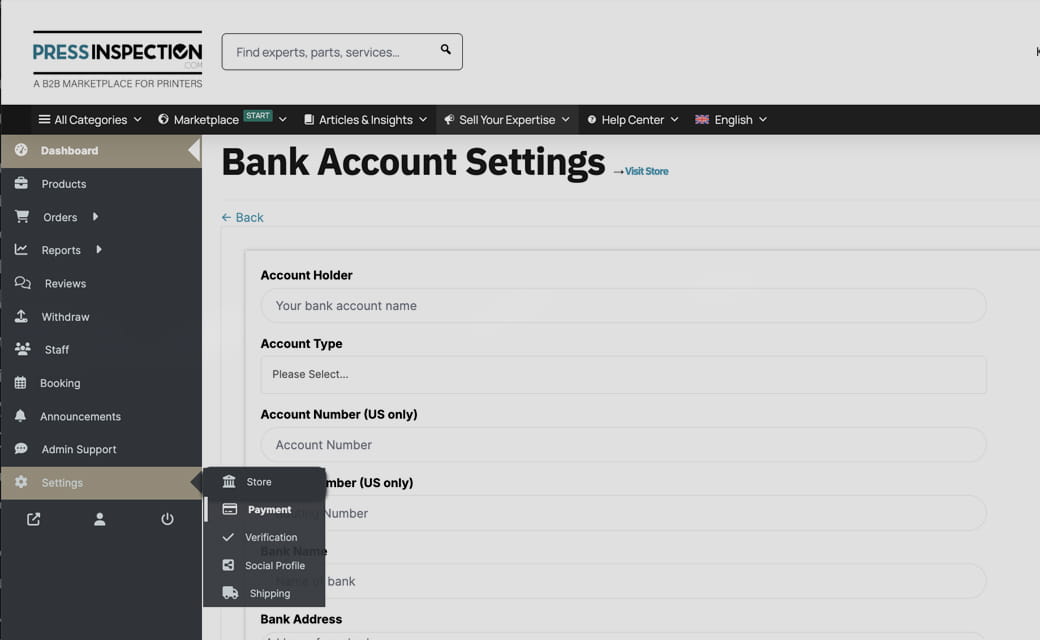
Step 3. Payment details and payouts (Payment Settings)
To receive payouts, complete the Payment / Withdraw section (names may vary, but the logic is the same):
-
Bank Transfer — bank details (IBAN, SWIFT/BIC, account holder name)
-
(if available) PayPal — your PayPal email
-
(if available) Stripe Connect — Stripe connection (if enabled for your store)
Screenshot A3: Payment Settings / Withdraw setup
Step 4. VAT number, taxes, and vendor responsibility
During registration, the vendor provides a VAT number / tax ID (depending on the country).
The vendor is responsible for:
-
the accuracy of the provided personal/company data;
-
paying their own taxes according to their local law;
-
complying with sanctions and applicable laws when providing services or selling goods.
How invoicing works (general logic)
- After the transaction, the vendor invoices the buyer directly (according to their own rules and local requirements).
-
The Pressinspection marketplace invoices the vendor for platform services and deducts the commission from the earned amount according to platform rules.
Note: this section is informational. If you need a precise invoicing model for your country, consult your accountant.
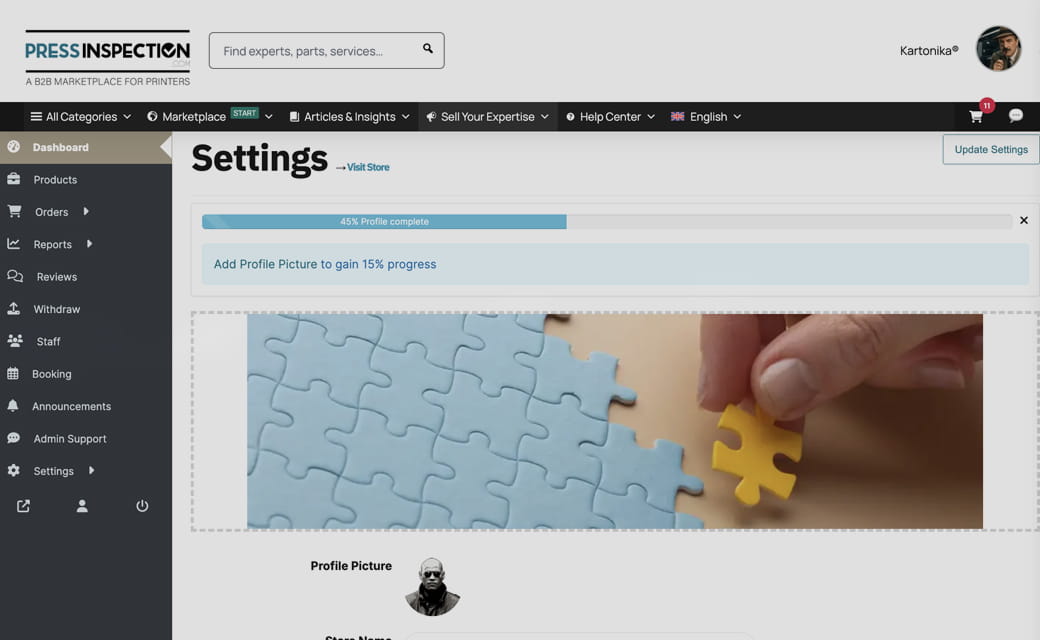
Step 5. Your public vendor page (Vendor Store Page)
After registration and approval, you receive your own public store page, for example:
https://pressinspection.com/vendor/username
On this page you can clearly present:
- who you are and what you do,
- your expertise,
- languages you can use,
- all your products and services,
- reviews and rating.
Why this matters:
If you are a freelancer or a service engineer working “on call”, you often don’t need to build a separate website and promote it from scratch. Your Pressinspection vendor page works as a ready-to-use professional landing page, already visible to our audience.
Screenshot A4.1 and A4.2: Example vendor store page
Step 6. Verification and trust
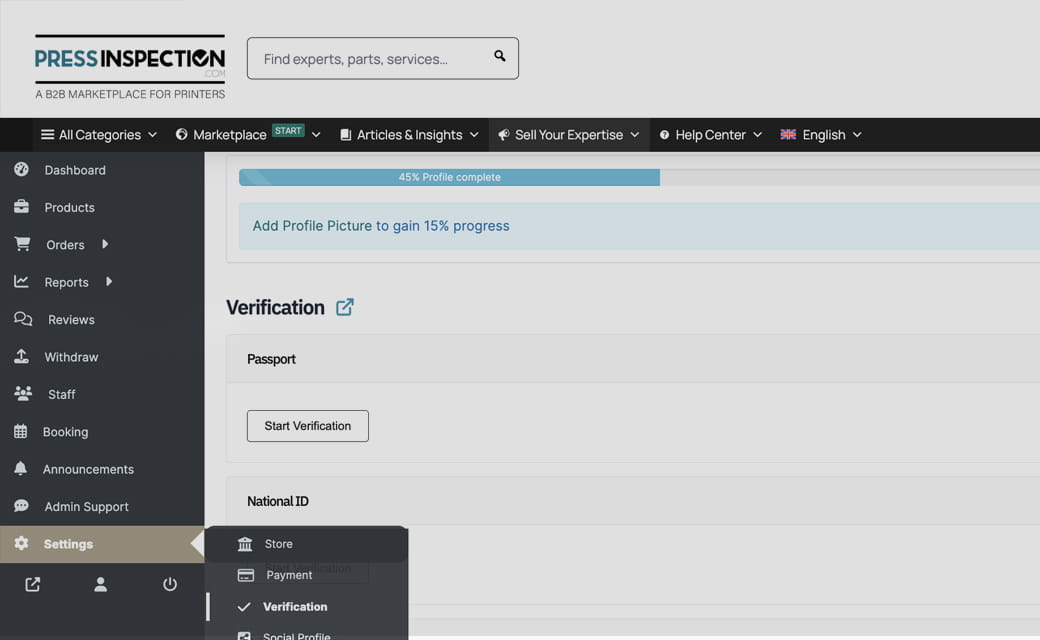
Vendors can pass verification and, if required, provide documents.
Why verification helps:
-
buyers trust verified vendors more;
-
your profile may appear higher in the directory/search (depending on settings);
-
your conversion to inquiries and orders improves.
Screenshot A5: Verification / documents section
Step 7. SEO settings and Social Profiles — why they matter
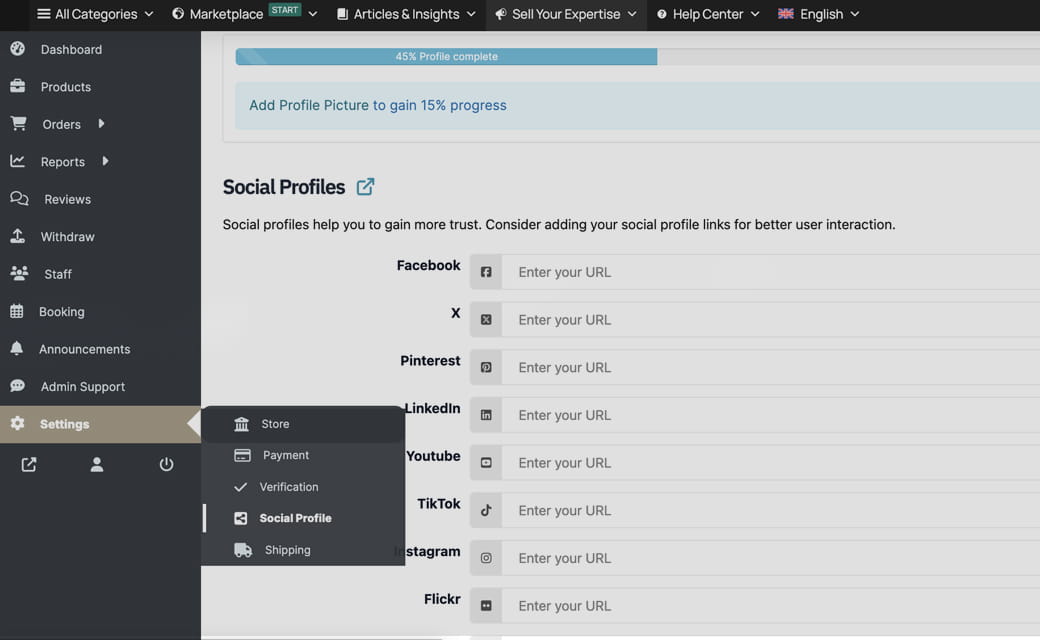
In your store settings you will see blocks such as SEO Settings and Social Profiles.
Why SEO matters
Our platform does not block vendor pages from indexing. After approval, your store page can rank in search engines like a normal website.
What the SEO block can provide:
clearer page title and description in Google;
more organic traffic to your page;
higher brand awareness and trust.
Why your social profiles are important
Links to LinkedIn, your company website, portfolio, Behance, Instagram, YouTube, GitHub (if relevant), etc.:
prove your credibility and experience,
increase trust (“I can verify this person/company”),
improve the likelihood of contact and purchase.
Screenshot A6: Social Profiles section
SEO is not “magic overnight,” but long-term it’s one of the cheapest and most reliable customer channels.
B) How to choose your store category and what to offer
On Pressinspection it is profitable to think not in one listing, but in a line of offers: product + training + service + consulting.
Example:
Suppose you sell equipment and you are an expert in dry ice cleaning. You can:
-
list equipment in the Equipment category
-
provide training services for equipment buyers
-
provide on-site cleaning services (On-site services)
-
provide paid consulting via Google Meet
Result: buyers see you not just as a seller, but as an expert who can deliver a complete solution.
If you are new to marketplaces: store setup assistance service
If a vendor finds it difficult to set up the store and listings, they can use a third-party store setup service.
Available packages, for example:
-
10 listings
-
20 listings
(and more if you add them)
How it works:
-
the vendor purchases a package,
-
sends the performer the materials: photos, specs, texts, prices,
-
the performer creates the listings, uploads photos, and publishes offers in the vendor’s store.
C) Vendor Dashboard menu overview — what each item does
Below is a “map” of the dashboard menu. You can place the corresponding screenshots next to each section.
1) Store setup (Store / Settings)
Here you configure the appearance and content of your vendor store page:
-
Banner — your store cover image
-
Logo / Profile photo
-
Store Description — what you do, your strengths, geography, specialization
-
Country
-
Languages
-
Social Profiles
-
(if available) SEO Settings — title/description/basic parameters
Recommendations:
-
The banner and logo should look professional and be readable on mobile.
-
Start your description with specifics: “I do X for Y to achieve Z.”
-
Mention 2–5 key services/task types — buyers scan quickly.
Screenshot C1: Store Settings
2) Products (Goods and services)
Best for: machines, parts, rollers, measuring devices, upgrade kits, etc.
2.1 Physical Products (Goods)
What matters in a listing:
-
Title — clear and specific (brand + model + condition/bundle)
-
Short Description — “who it’s for and why”, 3–7 bullets
-
Long Description — details, bundle contents, condition, compatibility, terms
-
Product Images — main image should show the item clearly
-
Category / Tags
-
Price — transparent and honest
-
Shipping — the shipping cost for delivering the product (if you ship)
2.2 Services without booking
Best for:
-
repair/refurbishment,
-
one-time freelance jobs,
-
tasks where the date/time is agreed after payment.
How an order is closed (general logic):
-
the buyer pays,
-
you contact the buyer (scope, timing, format),
-
you deliver the work,
-
you provide the result / confirmation of completion,
-
you mark the order as completed (Completed) according to dashboard rules.
2.3 Services with booking
Best for:
-
Google Meet consultations 15/30/45 minutes,
-
on-site services on a selected date,
-
anything where buyers need a time slot.
Logic:
-
the buyer selects a date/time,
-
pays,
-
you confirm/prepare the service,
-
you deliver the service,
-
you close the order.
Screenshot C2: Products list
Screenshot C3: Add New Product / Edit Product
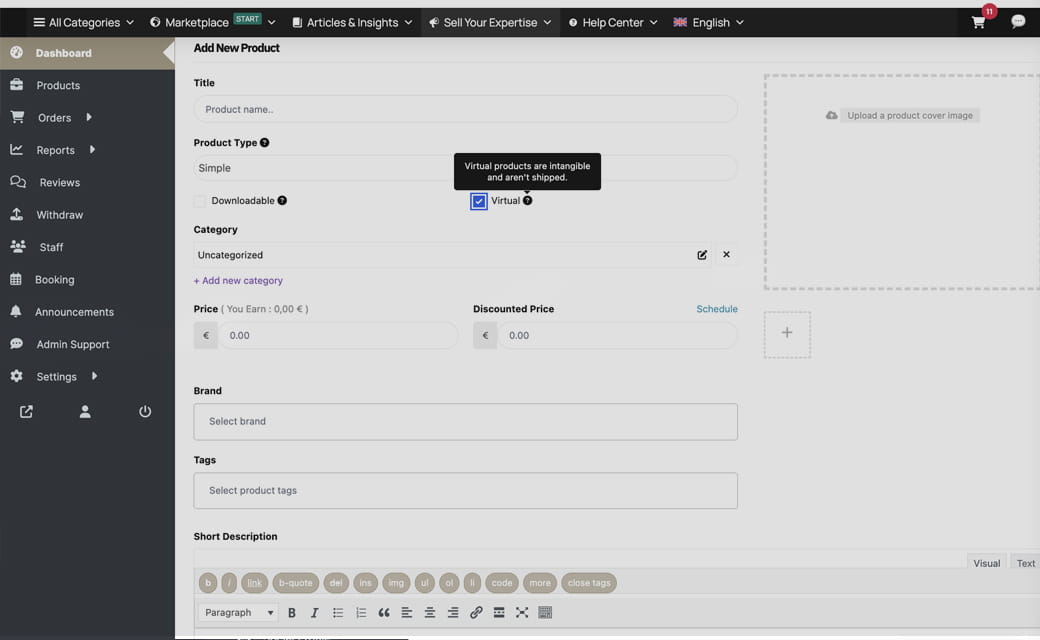
On the Add New Product page, you can offer new and used goods, as well as services that do not require booking by time (for example, if a customer sends you a spare part for repair, or if you manufacture products to order).
To provide services with booking, use the corresponding section in the menu.
Here you fill in:
Product title (the name that will be displayed on the card in the shop)
Product Type – here you choose whether it is a single product or service, or whether it has variations (for example, the same product that differs in size. Example: dismantling printing machine X costs 100 euros, and dismantling machine Y costs 105 euros. Both of these options can be formalised as variations of one service, and the buyer will choose the product they need.
Category – select one of the categories that are already listed in the All Categories menu (if your category is not there, write to us for help via the FAQ for vendors, and we will add it especially for you).
Price – specify the price. When you enter the number, you will immediately see the amount of your earnings minus our commission. Discounted price – specify the discounted price if you are holding a sale or promotion.
Brand – select from the list if your product is branded.
Tags – add your own tags that buyers can use to search for your product (e.g. Sale or Special Offer)
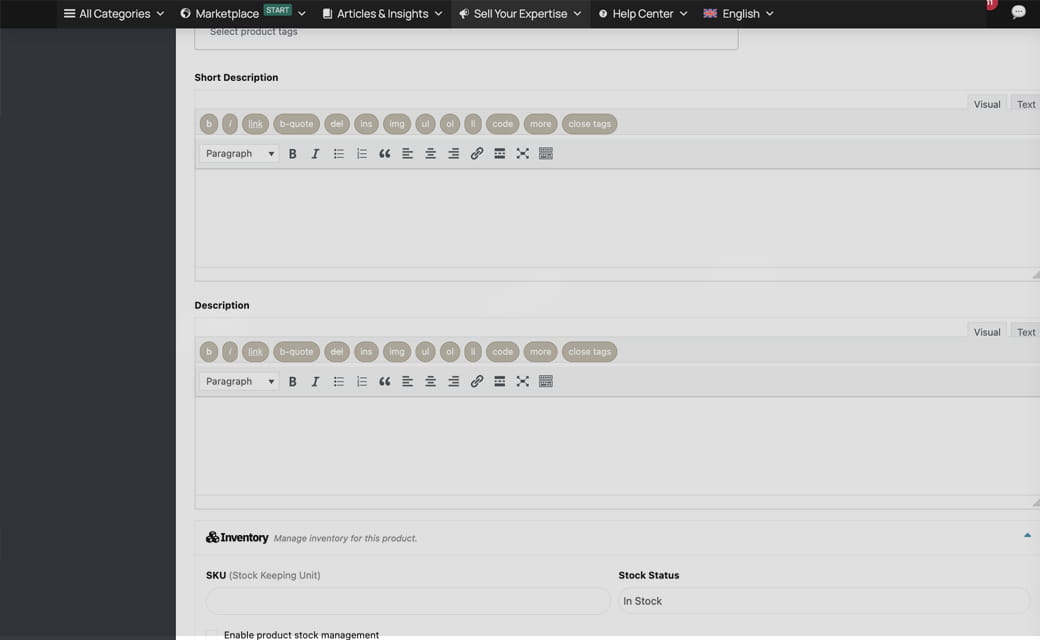
You will see two fields to fill in:
Short product description – what it is and what it is used for. This field is displayed next to the price. It should contain the most important information about the product or service.
Long product description – technical specifications, description. Here you can place media files – links to videos, photos, PDF catalogues.
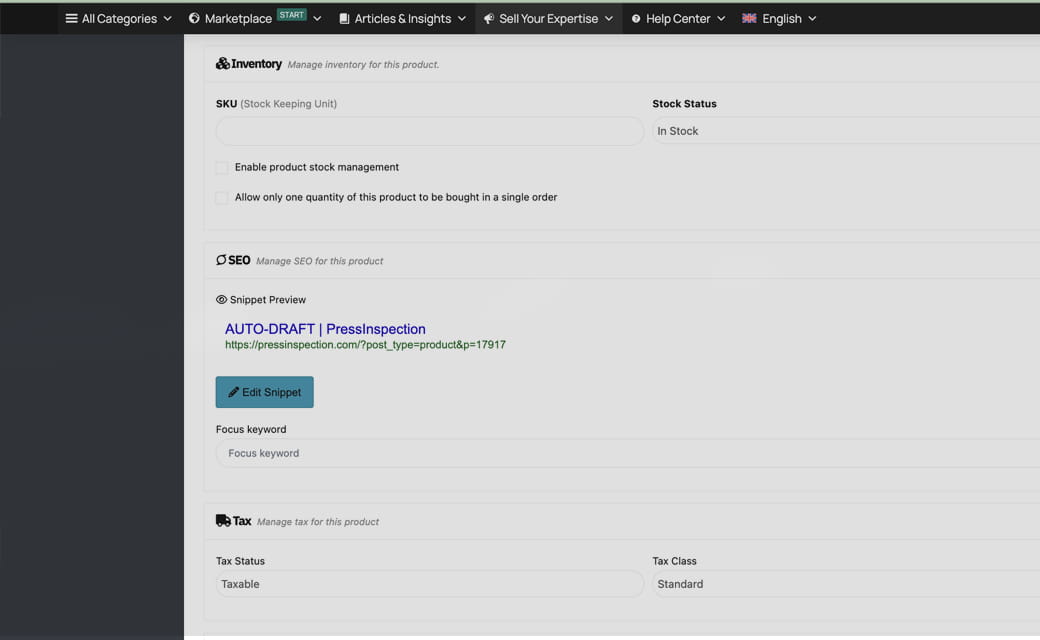
In the Inventory section, fill in the information about the product/service for your records:
SKU (Stock Keeping Unit) – this is the item number
Stock Status: here you can choose from
– In stock – available for sale/order and displayed on the marketplace
– Out of Stock – sold out and unavailable. The product is not displayed in the store.
– On Backorder – for goods: not in stock, but available to order. For services – available by additional agreement. This category is suitable when performing work for a specific customer order, the production of which will take time (for example, embossing dies, cutting dies, etc.).
SEO – we have already mentioned that your landing page will largely replace your website. When configuring a product/service, you can also configure how it is displayed in search engines. It is recommended that the description be no longer than 200 characters.
Tax – here you specify all the tax information for your product or service. You invoice the customer directly, and the platform invoices you for payment. Taxes are calculated using the B2B system (tax offset on the buyer’s side). The system will automatically calculate your tax based on your location and the buyer’s location.
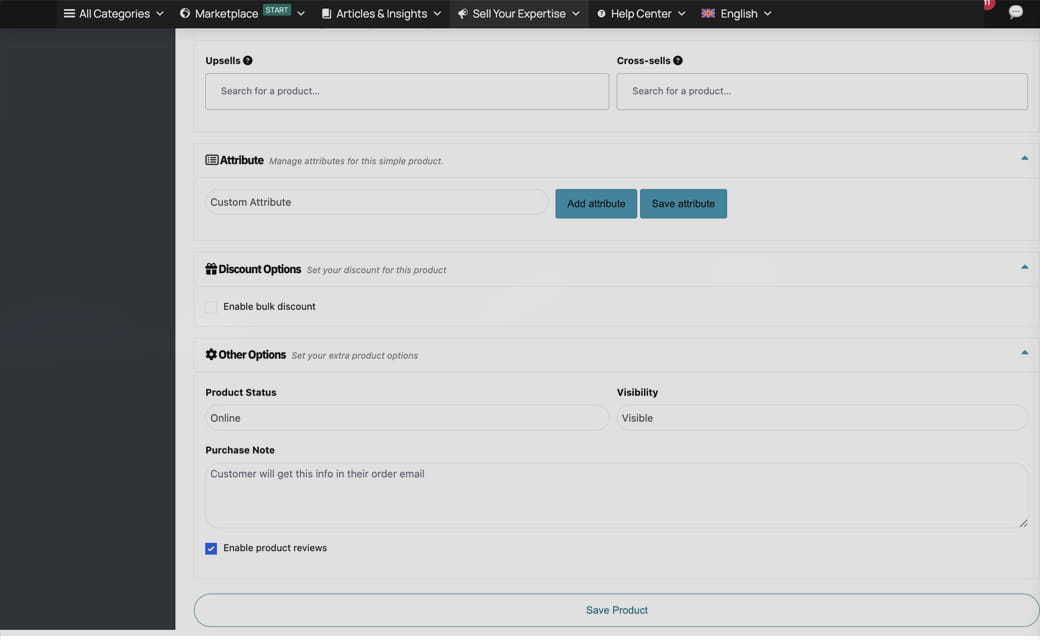
Linked Products – products and services that you can offer alongside your current product. For example, when selling equipment, you can also add a dismantling service, commissioning service, or selection consultation. The more cards (products and services) you have, the greater your value = higher profit.
Attribute – add your own attributes to the description (e.g., colour, configuration).
Enable Bulk Discount – if a customer purchases something else from your shop in a single purchase, specify a discount for them when completing the transaction.
Product Status – is this product published (displayed in the store) or is it a draft (not displayed).
Enable Product Review – enable this option if you want the buyer to share their opinion about your product or service. Each review raises your card and makes it more visible to potential buyers.
Product variations — when they are useful
Use a Variable Product when your offer has options:
-
different bundles,
-
different formats,
-
different deadlines,
-
different consultation durations (if you are not using booking, but fixed options).
Variations reduce friction and help buyers choose without extra messaging.
“Shipping” for services — how to interpret it correctly
For On-site services, shipping can mean travel costs (transport/accommodation).
In your service listing, clearly explain what “shipping” includes and what affects the amount.
For physical goods, shipping is standard delivery cost.
What the marketplace guarantees (transaction logic)
- Payment is made upfront so the vendor can confidently plan delivery of service or shipment of goods.
- We use payment infrastructure (e.g., Stripe) and transaction protection mechanisms.
- Platform activity may be additionally protected by insurance (e.g., Allianz Group) — within platform terms.
If the price changes or an advance is needed — what to do
A practical approach:
if the price changes before payment — update the listing price or create a separate listing/variation for that buyer;
if an advance/deposit is required — use an agreed mechanism (e.g., a separate “Deposit/Advance” product or another platform-supported format).
Main rule: all amount changes must be agreed with the buyer before payment, and the terms should be reflected in the listing or message thread.
Commission and your earnings calculation
On Pressinspection, commission can depend on the amount:
the higher the amount — the lower the percentage, because each payment has fixed processing costs
When you enter a price, the system shows:
-
your earnings,
-
the platform service fee/commission.
3) Image requirements
To keep listings consistent and fast:
-
aspect ratio: square 1:1
-
recommended resolution: 1200×1200 px
-
file format: JPG or WebP
-
recommended file size: up to 200–300 KB per image
Tips for attention-grabbing images:
-
main image should instantly show the essence (product close-up / service in action / before-after result);
-
avoid small text on images — it is unreadable on mobile;
-
clean background and good lighting beat “effects.”
Screenshot C1: Image upload / Product gallery
4) Orders
In Orders, you see all orders and their statuses.
Common statuses:
-
Pending / On-hold
-
Processing
-
Completed
-
Cancelled / Refunded
What the vendor does:
-
checks order details,
-
contacts the customer (scope/shipping/time slots),
-
records completion (per dashboard rules),
-
if needed adds tracking/comments/result files.
5) Reports
Reports show analytics for your store. Typical items:
-
Products
-
Revenue
-
Orders
-
Variations
-
Categories
-
Stock
-
Statement — the most important item
Statement — the key finance section
Statement helps you understand:
-
what buyers paid,
-
what part is the platform fee/commission,
-
what amount is available for payout,
-
what payouts were already made,
-
the period for each statement.
Recommendation:
-
reconcile Statement with your invoices/internal accounting;
-
keep proof of service delivery (report, messages, tracking) — helpful in disputes.
Screenshot C2: Reports menu
Screenshot C3: Statement (periods, amounts, details)
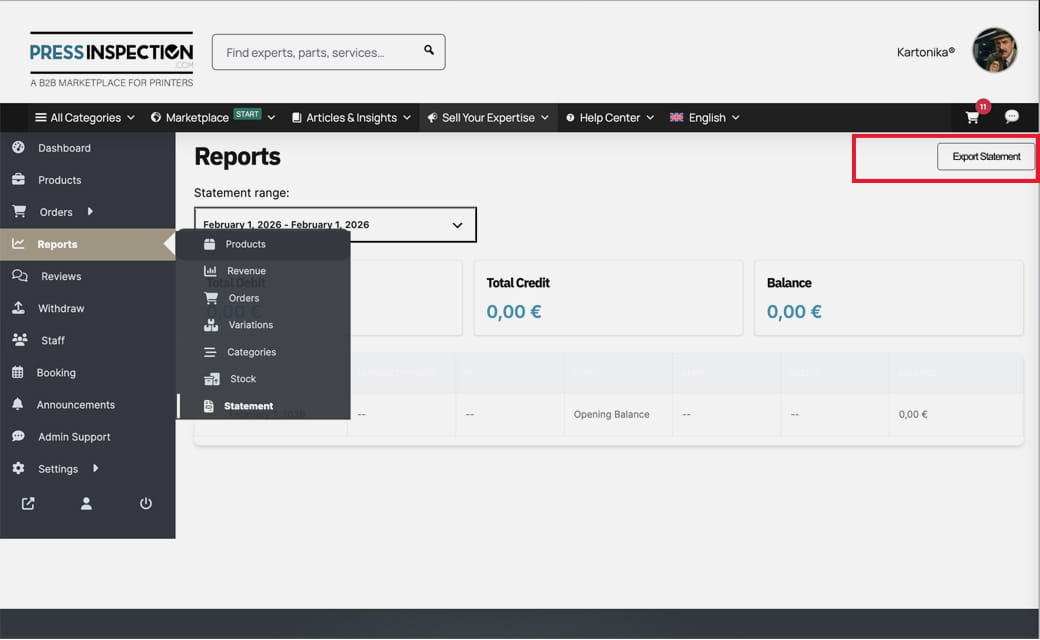
Reports is your main menu item. Here you will see all reports on sales and purchases, invoices issued. Here you can download a Statement – a report on your activities for your accounting department.
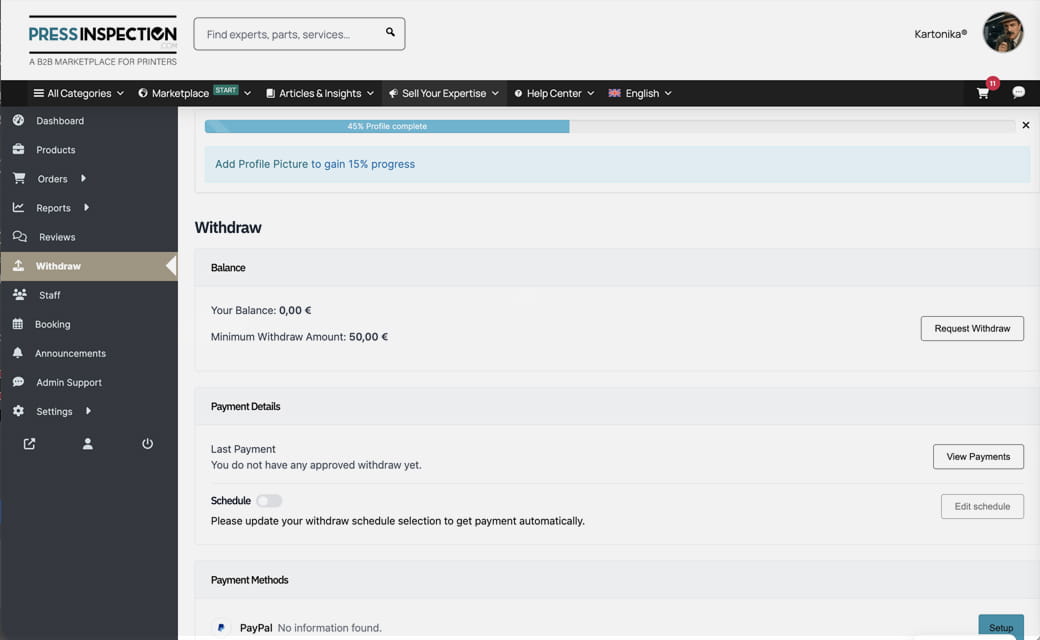
The Withdraw page is all about payments for your completed work. Here you can see the amount owed to you, set up your payment schedule and payment methods.
If you haven’t set up your bank accounts or PayPal yet, do so on the Withdraw page.
6) Reviews
Reviews in marketing are one of the strongest trust signals.
The more genuine reviews and the higher the rating, the easier it is for buyers to choose you.
Why reviews matter:
-
they increase trust without “advertising,”
-
they improve conversion,
-
they build your reputation and expertise showcase.
How to request reviews properly:
-
after completion, politely ask the customer to leave a review,
-
explain that reviews help other buyers,
-
reply to reviews — it builds trust.
Screenshot C4: Reviews
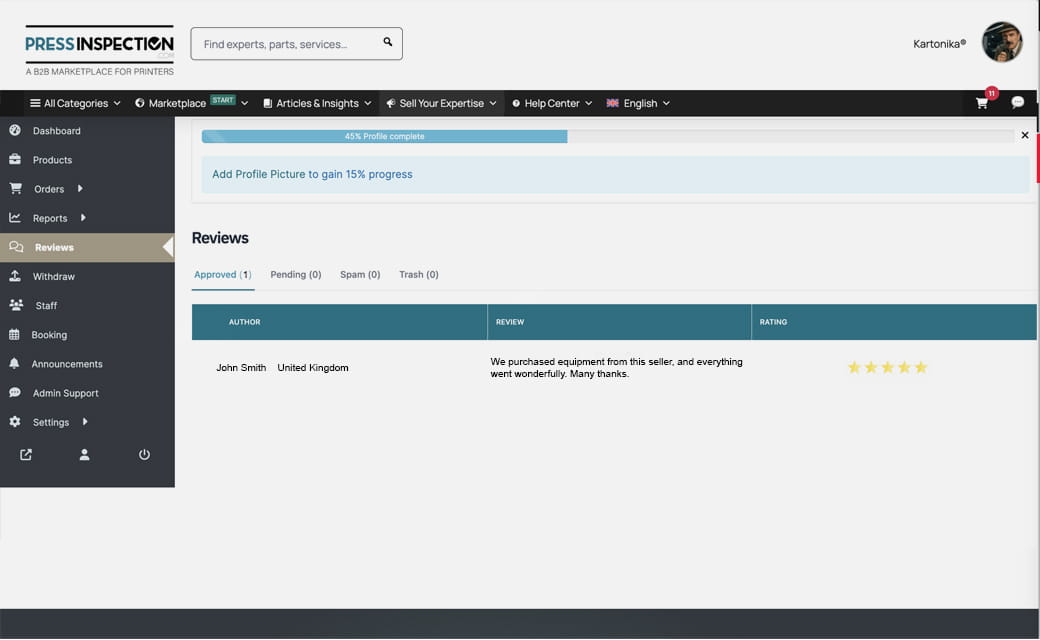
Your Vendor Dashboard is your best showcase. Strong reviews turn your profile into proof of reliability.
7) Withdraw
Payouts are made according to the platform schedule:
-
the platform collects payments for your goods/services,
-
issues a separate invoice for platform services,
-
pays out on a specific date (usually 1–2 times per month, according to platform rules).
In Withdraw you see:
-
available balance,
-
payout history,
-
payout statuses,
-
payout method settings.
Screenshot C5: Withdraw
8) Booking
Booking is for vendors selling time-slot services:
-
Google Meet consultations,
-
on-site service on a selected date,
-
any services with slots.
Setup recommendations:
-
set working days/hours,
-
add buffers between slots,
-
define reschedule/cancellation rules,
-
ask customers to provide the topic/input beforehand (better service quality),
-
after confirmation, send the link/instructions (or use built-in integration if enabled).
Screenshot C11: Booking settings / Calendar view
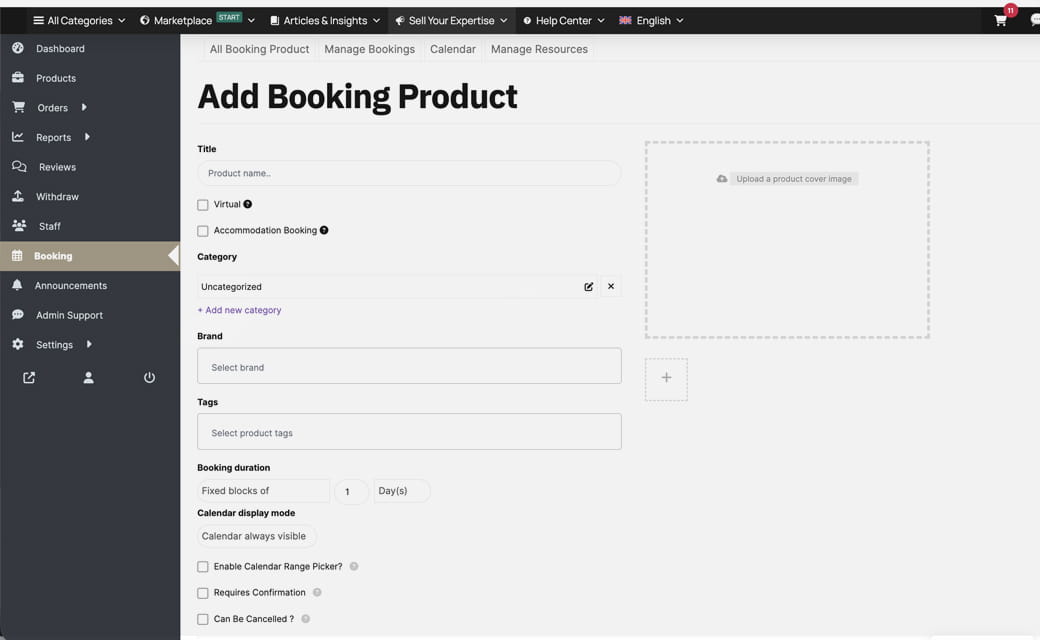
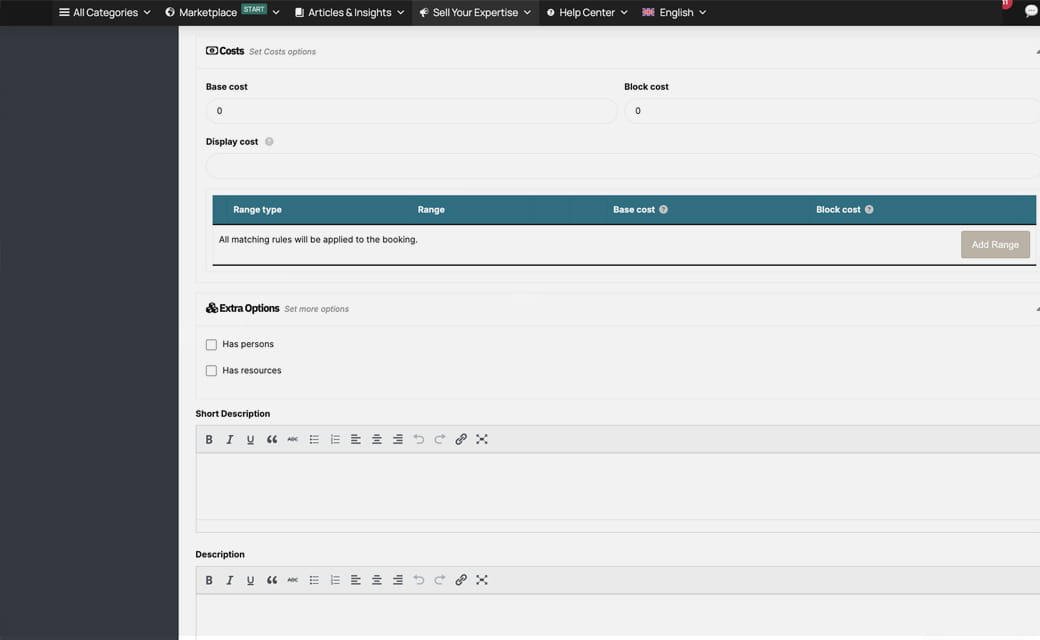
Virtual — select this option if you provide services rather than sell goods.
Accommodation booking — select this option if this product requires travel.
Booking Duration — set the number of days you need to prepare before performing the service.
Calendar — you can set up your card to provide a service for a specific time (for example, from 9:00 to 17:00), require mandatory confirmation from you, and specify whether the booking can be cancelled. The buyer will see these options in the shop.
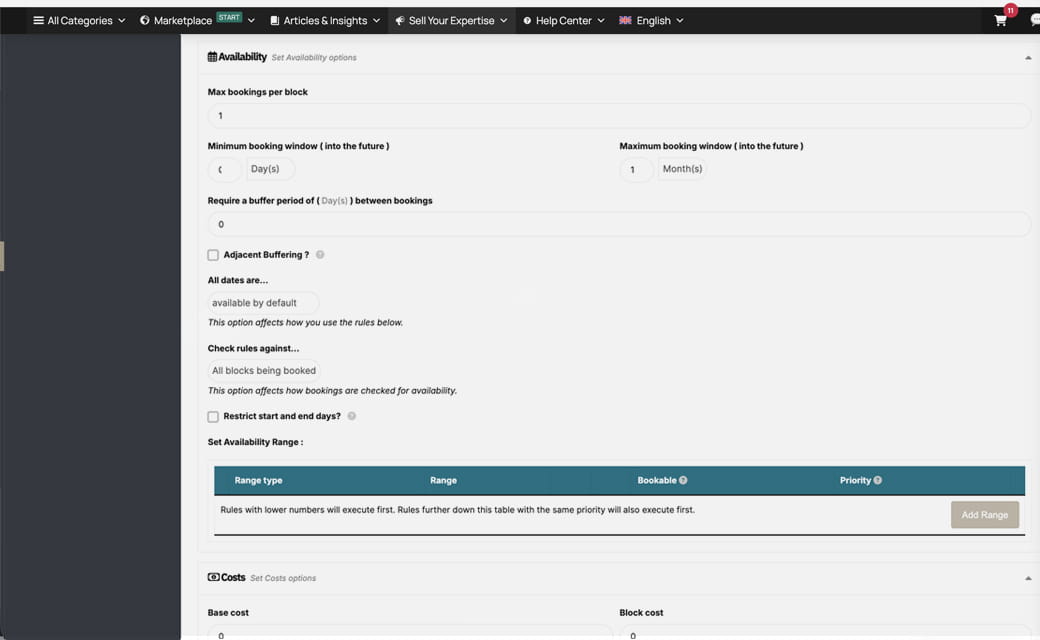
On the next page, you can configure your service terms and conditions.
9) Vendor promotion (Coming soon)
Right now, the main organic growth comes from:
-
complete profiles (SEO + Social Profiles),
-
high-quality listings,
-
reviews,
-
mentions/publications.
Planned features (coming soon):
-
email newsletters about vendor products,
-
homepage/blog announcements,
-
ad placements,
-
listing promotion mechanisms (featured, boosted listings, etc.),
-
ability to buy a blog article placement.
If you want promotion now, consider publishing an article/case study on the Pressinspection blog (format and terms to be defined separately).
Quick vendor checklist (1 minute)
✅ 90–100% profile completion (Profile Progress)
✅ Banner + logo + description + country + languages
✅ Payment Settings completed (for payouts)
✅ Social Profiles and basic SEO fields added
✅ Listings have square 1200×1200 images and clear descriptions
✅ “Shipping” meaning is explained for on-site services
✅ Booking configured (if you sell consultations/slots)
✅ You request reviews after completing orders
PROVISION OF SERVICES

Exploité par Kartonika Sp. z o.o. (UE) et ses sociétés affiliées
Paiements sécurisés

A B2B Platform for Printers
© 2026 PressInspection™ Tous droits réservés.
© 2026 PressInspection™ Tous droits réservés.